
Most e-commerce stores lose over half their potential customers before they even reach the site. Why? Poor search visibility. The gap between top-ranking stores and everyone else isn’t luck or budget, it’s strategic SEO execution. When you optimize product pages, category pages, site structure, technical elements, and content, you attract high-intent organic traffic that converts to sales. This guide walks you through proven strategies to elevate your store’s rankings, drive qualified visitors, and turn searches into revenue.
Table of Contents
- Understanding e-commerce SEO fundamentals
- Preparation: Setting your site up for SEO success
- Execution: Practical strategies for optimizing e-commerce pages
- Verification and ongoing improvement: Measuring and refining your SEO impact
- Next steps: Tap into expert-led e-commerce SEO solutions
- Frequently asked questions
Key Takeaways
| Point | Details |
|---|---|
| Category pages drive traffic | Optimizing category pages for commercial keywords brings broader visibility and attracts high-intent shoppers. |
| Unique content is essential | Product and category pages need substantial unique content to rank well and encourage conversions. |
| Technical SEO powers growth | Solid site structure, schema, and speed improvements lay the groundwork for e-commerce SEO success. |
| Continuous testing yields results | Regular measurement, refinement, and A/B testing help sustain and grow organic sales. |
Understanding e-commerce SEO fundamentals
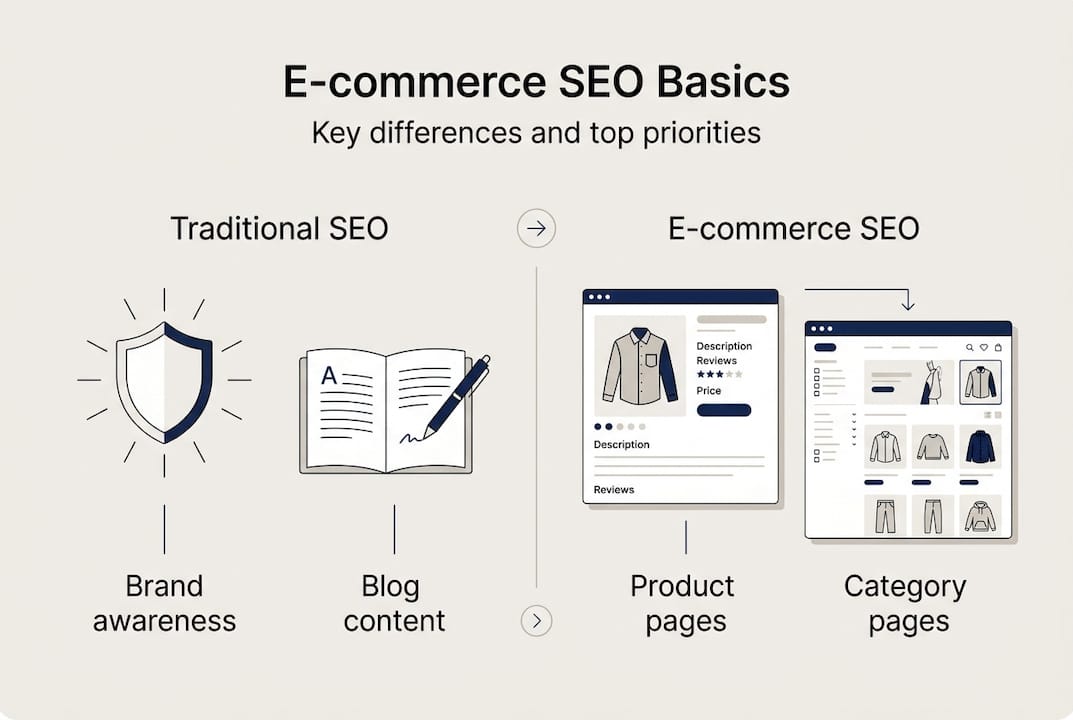
E-commerce SEO differs fundamentally from traditional website optimization. While standard SEO focuses on informational content and brand awareness, e-commerce SEO targets transactional intent at scale across hundreds or thousands of product and category pages. Your goal is to capture shoppers actively searching to buy, not just browse.
The core elements include product pages optimized for specific items, category pages targeting broader commercial keywords, technical infrastructure that supports crawling and indexing, and strategic internal linking that distributes authority throughout your site. Key mechanics include keyword research targeting transactional and commercial intent queries, unique product descriptions (300+ words for high-value items), category page optimization with substantial unique content above and below product grids, and proper internal linking.
Category pages deserve special attention. They capture broader search demand than individual product pages and often rank for high-volume commercial keywords. A well-optimized category page with unique content, clear navigation, and strategic product placement outperforms thin pages that simply list items.
Key differences between e-commerce and traditional SEO:
| Element | Traditional SEO | E-commerce SEO |
|---|---|---|
| Primary goal | Brand awareness, information | Direct sales, conversions |
| Content focus | Blog posts, guides | Product/category pages |
| Keyword intent | Informational | Transactional, commercial |
| Scale | Dozens of pages | Hundreds to thousands |
| Conversion metric | Engagement, leads | Revenue, transactions |
Unique content matters more than ever. Duplicate manufacturer descriptions hurt your rankings and fail to differentiate your store. Invest in original descriptions that address customer questions, highlight benefits, and incorporate target keywords naturally.
Internal linking creates pathways for both users and search engines. Link related products, connect categories to subcategories, and use breadcrumb navigation to establish clear site hierarchy. This distributes page authority and helps search engines understand your catalog structure.
When building an effective online store, prioritize these fundamentals from day one. Technical debt compounds quickly in e-commerce, making later fixes exponentially harder. Start with solid SEO basics for websites and layer in e-commerce-specific tactics.
For deeper technical insights, explore advanced e-commerce SEO tips that cover schema implementation, faceted navigation, and handling out-of-stock products.
Preparation: Setting your site up for SEO success
Before optimizing content, ensure your technical foundation supports SEO. A poorly structured site undermines even the best content strategy. Start with these essential checks:
Technical SEO readiness checklist:
- Site speed: Pages must load under 3 seconds on mobile
- Mobile responsiveness: Test all templates on multiple devices
- HTTPS security: SSL certificates are non-negotiable
- XML sitemap: Submit to Google Search Console
- Robots.txt: Verify proper crawl directives
- Structured data: Implement product schema markup
- Canonical tags: Prevent duplicate content issues
- 404 handling: Create helpful error pages with navigation
URL structure impacts both user experience and search performance. Use clean, descriptive URLs that reflect your site hierarchy. For example: "yourstore.com/category/subcategory/product-namebeatsyourstore.com/p?id=12345`. Keep URLs short, include target keywords, and avoid unnecessary parameters.
Essential tools for e-commerce SEO in 2026:
| Tool category | Purpose | Examples |
|---|---|---|
| Analytics | Traffic, behavior, conversions | Google Analytics 4, Adobe Analytics |
| Search Console | Indexing, queries, technical issues | Google Search Console, Bing Webmaster |
| Keyword research | Intent analysis, volume data | Ahrefs, SEMrush, Keyword Planner |
| Technical audit | Crawl errors, speed, mobile | Screaming Frog, Sitebulb |
| Schema testing | Structured data validation | Google Rich Results Test |
Entity SEO, log analysis, advanced schema for variants represent critical 2026 trends. Entity SEO focuses on how search engines understand relationships between products, brands, and categories beyond simple keywords. Log analysis reveals how search bots actually crawl your site, exposing inefficiencies in crawl budget allocation.
Advanced schema for product variants helps search engines distinguish between sizes, colors, and configurations. This granular data improves visibility in shopping results and rich snippets.
Pro Tip: Blend AI tools with human oversight for content creation. AI accelerates production but lacks the nuanced understanding of customer pain points and brand voice that drives conversions. Use AI for research and drafts, then refine with human expertise.
When working with responsive SEO-friendly sites, ensure your platform supports these technical requirements natively. Retrofitting SEO into poorly built stores costs more than starting correctly. Optimizing site speed alone can improve rankings and reduce bounce rates significantly.
For comprehensive preparation steps in e-commerce SEO, audit your current setup against industry benchmarks and prioritize fixes that impact both crawlability and user experience.
Execution: Practical strategies for optimizing e-commerce pages
With technical foundations in place, focus on content optimization that drives rankings and conversions. This section provides actionable steps for keyword research, page optimization, and strategic content creation.
Step 1: Conduct keyword research for transactional intent

Start by identifying keywords shoppers use when ready to buy. Transactional keywords include “buy,” “price,” “discount,” “free shipping,” and product-specific terms. Commercial investigation keywords like “best,” “review,” “comparison,” and “vs” capture shoppers in the consideration phase.
Use keyword tools to find:
- High-volume product keywords with purchase intent
- Long-tail variations with lower competition
- Category-level commercial keywords
- Question-based queries for FAQ content
Prioritize keywords by search volume, competition level, and alignment with your catalog. Don’t chase keywords for products you don’t sell or can’t compete on.
Step 2: Create unique, substantial product descriptions
Keyword research targeting transactional and commercial intent queries, unique product descriptions (300+ words for high-value items) form the backbone of product page optimization. Generic manufacturer descriptions won’t differentiate your store or rank well.
For each high-value product:
- Write 300+ words of original content
- Address common customer questions
- Highlight unique benefits and use cases
- Include target keywords naturally in headings and body text
- Add technical specifications in structured format
- Incorporate customer language from reviews and support tickets
Step 3: Optimize category pages for commercial keywords
Category pages capture broader search demand than individual products. A well-optimized category page ranks for dozens of related keywords and serves as a hub for internal linking.
Optimize category pages by:
- Adding 500+ words of unique content above the product grid
- Including target keywords in H1, meta title, and description
- Creating descriptive introductions that explain category value
- Adding buying guides or comparison content below products
- Implementing faceted navigation with proper canonicalization
- Linking to related categories and top products
Pro Tip: Balance SEO content with conversion optimization. Long blocks of text above products can hurt conversions. Test layouts that integrate content naturally, such as expandable sections or content below the fold.
Step 4: Integrate SEO with conversion rate optimization
Rankings mean nothing without conversions. Every SEO decision should consider user experience and sales impact.
“The best e-commerce SEO strategies drive both traffic and revenue. Optimize for search engines, but design for humans.”
Key integration points:
- Use persuasive, benefit-focused copy that includes keywords
- Optimize images for speed without sacrificing quality
- Implement clear calls-to-action on every page
- Add trust signals like reviews, guarantees, and security badges
- Test page layouts for both SEO content and conversion elements
Step 5: Implement schema markup strategically
Structured data helps search engines understand your products and can trigger rich results in search. Implement:
- Product schema with price, availability, and reviews
- Breadcrumb schema for navigation clarity
- Organization schema for brand information
- FAQ schema for common questions
- Review schema for aggregate ratings
Test all schema implementations with Google’s Rich Results Test to ensure proper formatting.
When optimizing your e-commerce website SEO, consider how each element supports both search visibility and user experience. Professional SEO services for e-commerce can accelerate implementation and avoid common pitfalls. Quality website development for SEO ensures your platform supports these optimizations natively.
For advanced tactics beyond basics, review advanced SEO strategies covering international SEO, handling seasonal inventory, and managing large-scale product catalogs.
Verification and ongoing improvement: Measuring and refining your SEO impact
Optimization without measurement is guesswork. Establish clear metrics, track performance consistently, and refine your approach based on data.
Key performance indicators for e-commerce SEO:
- Organic traffic: Total visits from search engines
- Keyword rankings: Position for target terms
- Organic revenue: Sales attributed to organic search
- Conversion rate: Percentage of organic visitors who purchase
- Pages indexed: Total pages in search engine indexes
- Crawl efficiency: How effectively bots access your content
- Core Web Vitals: Speed, interactivity, visual stability scores
Google Analytics 4 provides robust tracking for organic performance. Set up custom reports that segment organic traffic by landing page, device, and conversion path. Connect Analytics with Search Console for keyword-level insights.
Track revenue attribution beyond last-click to understand SEO’s true impact. Many customers discover products through organic search but convert through other channels. Multi-touch attribution models reveal how SEO contributes throughout the customer journey.
Revenue attribution methods:
- First-touch: Credits the initial traffic source
- Last-touch: Credits the final interaction before purchase
- Linear: Distributes credit equally across all touchpoints
- Time-decay: Gives more credit to recent interactions
- Position-based: Emphasizes first and last touchpoints
Choose an attribution model that reflects your typical customer journey. E-commerce often benefits from position-based or time-decay models that recognize both discovery and conversion touchpoints.
Refinement through testing:
Continuous improvement requires systematic testing. Run A/B tests on:
- Product description length and format
- Category page content placement
- Internal linking strategies
- Schema markup variations
- Meta title and description formulas
Test one variable at a time and allow sufficient time for statistical significance. SEO changes often take weeks to show full impact.
Log analysis reveals how search engines actually crawl your site. Analyze server logs to identify:
- Pages bots visit most frequently
- Crawl budget waste on low-value pages
- Technical errors blocking important content
- Opportunities to improve crawl efficiency
Entity SEO enhancements help search engines understand relationships in your catalog. Strengthen entity signals by:
- Consistent brand mentions across pages
- Clear product categorization and taxonomy
- Structured data connecting related items
- Internal linking that reinforces relationships
Key takeaways for ongoing SEO success:
| Action | Frequency | Impact |
|---|---|---|
| Monitor rankings | Weekly | Identify trends and opportunities |
| Review Analytics | Weekly | Track traffic and conversion patterns |
| Technical audits | Monthly | Catch and fix emerging issues |
| Content updates | Monthly | Refresh underperforming pages |
| Competitor analysis | Quarterly | Benchmark and identify gaps |
| Strategy review | Quarterly | Align SEO with business goals |
When tracking ROI with SEO, focus on metrics that connect directly to revenue. Traffic increases mean little without corresponding sales growth. For detailed guidance on monitoring SEO results, establish dashboards that surface actionable insights quickly.
Next steps: Tap into expert-led e-commerce SEO solutions
You now understand the strategic framework for e-commerce SEO success. But knowing and executing are different challenges. Implementation requires technical expertise, ongoing optimization, and staying current with algorithm updates and industry best practices.

Solution Clime specializes in SEO services for e-commerce that drive measurable revenue growth. Our team combines technical SEO expertise with deep e-commerce platform knowledge to optimize every element of your online store. We handle keyword research, content optimization, technical audits, and ongoing refinement so you can focus on running your business.
Whether you need advanced SEO guidance for an existing store or want to build expert e-commerce website solutions from the ground up, we deliver strategies tailored to your catalog, competition, and growth goals. Our approach integrates SEO with conversion optimization, ensuring traffic translates to sales.
Frequently asked questions
How is e-commerce SEO different from standard website SEO?
E-commerce SEO focuses on optimizing individual product and category pages for transactional intent and involves more complex site structures than standard websites. It prioritizes commercial keywords and conversion optimization alongside rankings.
What are the main technical SEO issues for e-commerce stores?
Common issues include poor URL structure, duplicate content, slow site speed, and lack of structured data. Entity SEO, log analysis, advanced schema for variants address modern technical challenges that impact visibility and crawl efficiency.
How many words should a product page description contain?
Aim for at least 300 words per high-value product page, focusing on unique content that improves both ranking potential and conversion rates. Lower-value items can use shorter descriptions if resources are limited.
Should category pages be prioritized for SEO?
Yes, optimizing category pages for commercial keywords attracts broader search demand and improves organic traffic more efficiently than focusing solely on individual products. Categories serve as hubs that distribute authority throughout your catalog.
How can I track SEO results and revenue attribution in 2026?
Use advanced analytics tools, entity SEO, log analysis, and go beyond last-click attribution for accurate measurement. Multi-touch attribution models reveal SEO’s full contribution to revenue across the customer journey.