
Mobile apps aren’t just for tech giants. Streamlined development methods put customized solutions within reach for small and mid-sized businesses. Understanding the process empowers better digital strategy decisions, helping you evaluate opportunities, manage budgets, and choose the right technical approach for your organization’s unique needs.
Table of Contents
- What is mobile app development?
- Key stages of the mobile app development process
- Types of mobile apps: native, cross-platform, and hybrid
- Which approach is best for your business needs?
- Common challenges and how to overcome them
Key Takeaways
| Point | Details |
|---|---|
| Structured development process | App creation follows seven key stages, each shaping cost, quality, and timeline. |
| Choose the right framework | Match native, cross-platform, or hybrid options to your business goals and resources. |
| Expect real business impact | Well-designed apps improve engagement, streamline operations, and boost revenue. |
| Plan for common pitfalls | Careful planning and ongoing maintenance reduce risk and ensure long-term app success. |
What is mobile app development?
Now that you see how accessible mobile apps can be for all businesses, let’s unpack what mobile app development really means.
Mobile app development is the process of creating software applications designed to run on smartphones, tablets, and other mobile devices. It involves planning, designing, coding, testing, and deploying applications that solve specific business problems or serve customer needs. The scope extends beyond consumer-facing apps to include internal tools, enterprise systems, and specialized business solutions.
Three primary types of mobile applications exist:
- Native apps: Built specifically for iOS or Android using platform-specific languages and tools
- Cross-platform apps: Developed with frameworks that generate code for multiple platforms from a single codebase
- Hybrid apps: Web-based applications wrapped in a native container for app store distribution
Businesses invest in mobile applications for compelling reasons. Apps create direct channels to customers, increasing engagement and building loyalty. They streamline internal operations by putting critical business functions in employees’ hands. Revenue opportunities emerge through e-commerce integration, subscription models, and enhanced service delivery.
“Mobile applications transform how businesses interact with customers and manage operations. The right app becomes a competitive advantage that drives measurable results.”
Understanding app development fundamentals helps you make informed decisions about technology investments. You can evaluate vendor proposals more effectively, set realistic timelines, and align app features with business objectives. This knowledge also clarifies how mobile solutions fit within your broader digital strategy alongside websites, cloud systems, and other IT and software services.

Key stages of the mobile app development process
With that high-level understanding, it’s important to see how app ideas move from concept to launch through a proven, stepwise process.
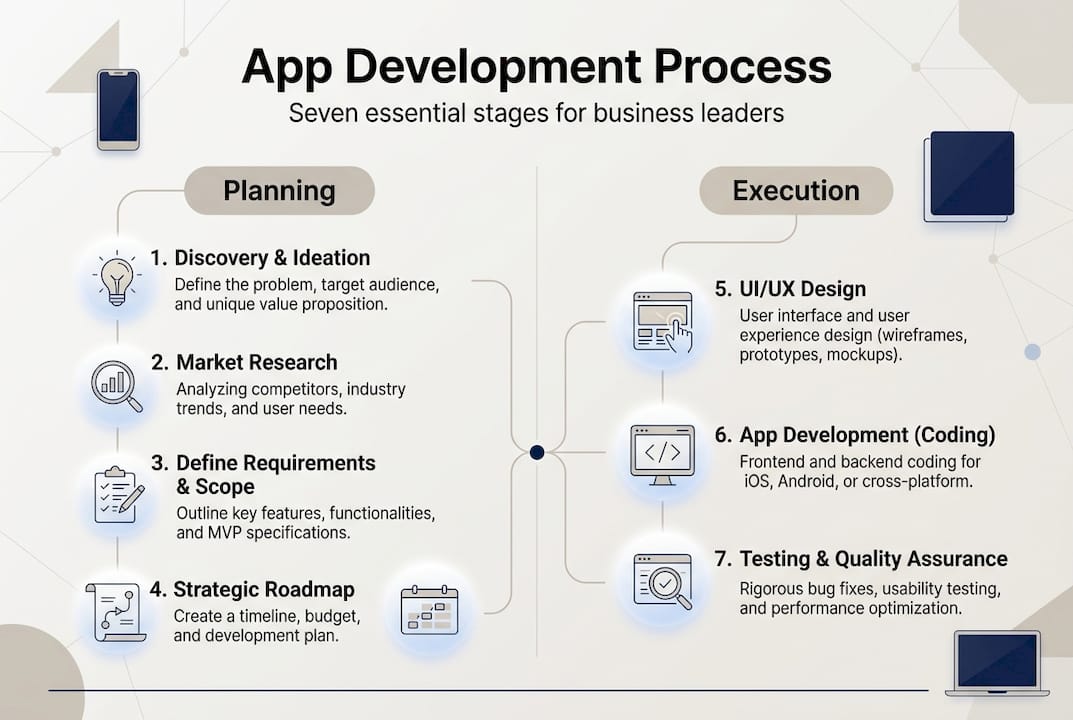
The process includes ideation and research, planning, UI/UX design, development, testing, deployment, and maintenance. Each stage builds on the previous one, creating a structured path from initial concept to market-ready application. A disciplined approach minimizes budget overruns and scope creep while ensuring the final product meets business requirements.
-
Ideation and research: Define the problem your app will solve, identify target users, and analyze competitor solutions. This stage establishes the business case and validates market demand.
-
Planning: Create detailed specifications including features, technical requirements, budget estimates, and project timelines. Document user stories and acceptance criteria.
-
UI/UX design: Develop wireframes, mockups, and interactive prototypes that map the user journey. Design decisions made here directly impact adoption rates and user satisfaction.
-
Development: Write code, integrate APIs, build databases, and implement business logic. This is typically the longest phase, where your chosen technology stack comes into play.
-
Testing: Conduct functional testing, performance testing, security audits, and user acceptance testing. Quality assurance prevents costly post-launch fixes.
-
Deployment: Submit to app stores, configure backend systems, and prepare marketing materials. Launch coordination ensures smooth public release.
-
Maintenance: Monitor performance, fix bugs, release updates, and add features based on user feedback. Ongoing support keeps your app relevant and functional.
Pro Tip: Build a minimum viable product (MVP) first. Launch with core features, gather real user feedback, then expand functionality based on actual usage patterns rather than assumptions.
Critical decision points occur throughout this process. During planning, you’ll choose between native, cross-platform, or hybrid development. Budget allocation happens early but requires flexibility for unexpected challenges. Post-launch plans need definition upfront because maintenance costs often equal 15-20% of initial development expenses annually.
| Stage | Typical Duration | Key Deliverable |
|---|---|---|
| Ideation & Research | 2-4 weeks | Business requirements document |
| Planning | 2-3 weeks | Technical specification |
| UI/UX Design | 3-6 weeks | Interactive prototype |
| Development | 8-20 weeks | Functional application |
| Testing | 2-4 weeks | Quality assurance report |
| Deployment | 1-2 weeks | Live application |
| Maintenance | Ongoing | Updates and improvements |
The software development lifecycle provides guardrails that keep projects on track. When you understand these stages, you can hold development teams accountable, recognize warning signs early, and make informed decisions about scope changes or timeline adjustments.
Types of mobile apps: native, cross-platform, and hybrid
Understanding these stages raises an important point. Your choice of app type shapes time, cost, and tech decisions.
Native applications deliver superior performance because they’re built specifically for iOS or Android using platform-native languages like Swift or Kotlin. They access device features directly, provide the smoothest user experience, and integrate seamlessly with operating system functions. However, native offers the best performance at higher cost and time investment since you need separate codebases for each platform.
Cross-platform frameworks like React Native or Flutter let developers write code once and deploy to both iOS and Android. This approach saves 40-50% costs compared to building two native apps. Performance is nearly native-quality for most business applications. The tradeoff comes with slightly limited access to cutting-edge platform features and occasional compatibility challenges.
Hybrid apps are essentially web applications wrapped in a native shell. They’re the fastest to build and most affordable option, making them ideal for content-focused apps, internal tools, or proof-of-concept projects. Performance lags behind native and cross-platform options, but for simple CRUD operations or information display, the difference rarely matters to end users.
Pro Tip: Match your app type to your specific use case. Don’t overpay for native development if your app primarily displays content and collects form data. Save native for apps requiring intensive graphics, real-time processing, or advanced device integration.
| App Type | Development Time | Cost Range | Best For |
|---|---|---|---|
| Native | 6-12 months | $80k-$250k | High-performance apps, games, AR/VR |
| Cross-platform | 4-8 months | $50k-$140k | Most business apps, e-commerce, social |
| Hybrid | 3-6 months | $30k-$80k | Content apps, MVPs, internal tools |
Business fit depends on multiple factors:
- App complexity: Simple data display suits hybrid; complex interactions need native
- Budget constraints: Limited budgets favor cross-platform or hybrid approaches
- Time to market: Faster launches point toward cross-platform or hybrid
- Performance requirements: Graphics-intensive or real-time apps require native
- Feature demands: Advanced camera, GPS, or sensor integration works best native
Consider how your app aligns with responsive design approaches used in your web presence. Consistency across digital touchpoints strengthens brand recognition and user trust. Your custom development strategies should create a cohesive ecosystem where mobile, web, and backend systems work together seamlessly.
Which approach is best for your business needs?
Now, let’s make that decision practical with targeted recommendations for common SME scenarios.
High-compute applications like AR, VR, or gaming should go native. These apps demand maximum processing power, smooth graphics rendering, and direct hardware access. The performance difference is noticeable and directly impacts user satisfaction. If your business model depends on delivering a premium, responsive experience, native development justifies the investment.
Cross-platform or hybrid approaches work well for CRUD operations (create, read, update, delete) or content-focused apps. Most business applications fall into this category: customer portals, inventory management, field service tools, or information resources. These apps prioritize functionality and data handling over graphics performance. The cost and time savings let you launch faster and iterate based on real user feedback.
Key tradeoffs to consider:
- Performance vs. cost: Native delivers peak performance but costs 60-80% more than cross-platform
- Development speed vs. optimization: Hybrid launches fastest but may require performance tuning
- Platform reach vs. maintenance: Cross-platform reaches both iOS and Android with one codebase to maintain
- Feature access vs. simplicity: Native provides full platform capabilities; hybrid has limitations
Pro Tip: Start with cross-platform for your MVP unless you have specific technical requirements that demand native development. You can always rebuild critical components natively later if performance becomes an issue.
Ask yourself these questions:
- Is user experience your primary competitive advantage, or is rapid deployment more critical?
- Will your app perform complex calculations, render 3D graphics, or process real-time data?
- Do you need cutting-edge features like advanced AR, machine learning on-device, or complex animations?
- What’s your budget ceiling, and how does it align with your feature requirements?
- How quickly do you need to reach market, and can you afford platform-specific development cycles?
Your answers reveal the right path. A retail business launching a product catalog with shopping cart functionality thrives with cross-platform. A real estate company building a virtual tour app with 3D walkthroughs needs native. An internal employee directory with basic search and contact features works perfectly as hybrid.
Integrate your mobile strategy with SEO-friendly web strategies and performance optimization practices. Mobile apps don’t exist in isolation. They’re part of a digital ecosystem that includes your website, backend systems, and customer touchpoints. Consistency in performance standards across all platforms builds trust and delivers reliable experiences.
Common challenges and how to overcome them
Even with the right approach, execution can stall, so be aware of hazards and how to sidestep them.
Challenges include scope creep, bugs, poor UX, and failure to plan for scalability. These issues derail projects, inflate budgets, and delay launches. Understanding common pitfalls helps you implement preventive measures from day one.
- Scope creep destroys budgets and timelines: Features multiply as stakeholders add